 WebTicTacToe
How to Win at Tic Tac Toe Every Time
Master the mathematics, opening moves, defensive counter-plays, and advanced fork traps of Tic Tac Toe. A complete, expert-written guide to perfect play.
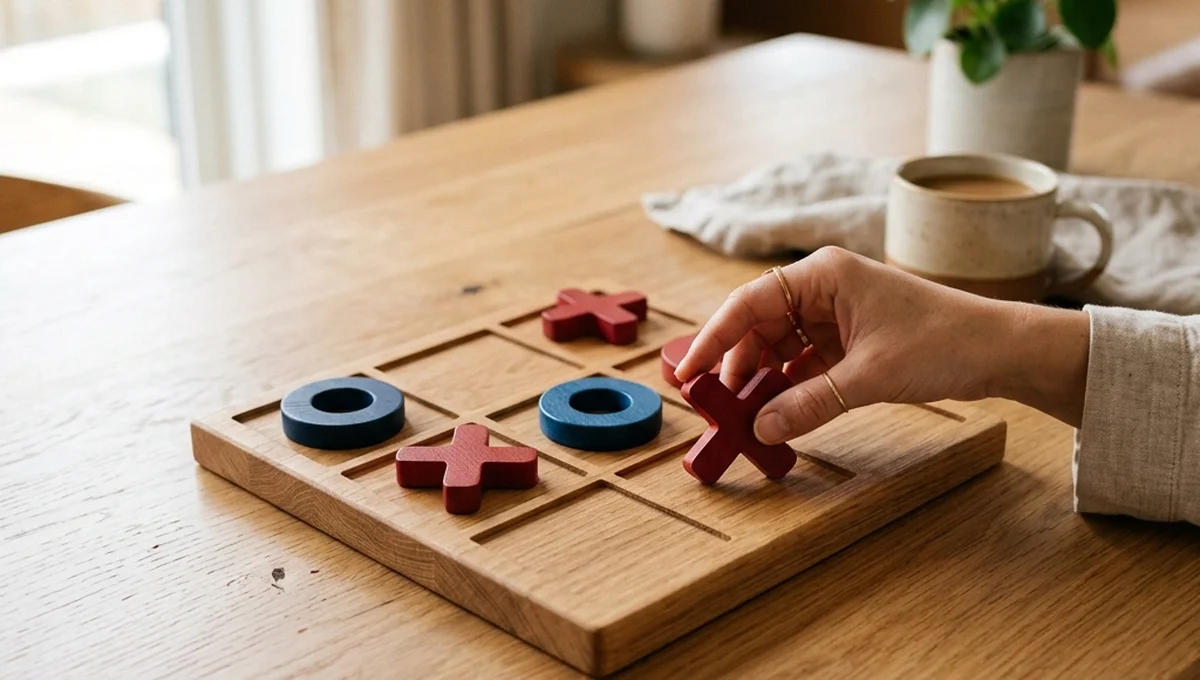
Featured Snippet: How to Win at Tic Tac Toe
To guarantee a win or draw in Tic Tac Toe, you must follow the rules of perfect play. If you go first (Player X), open by taking the center or a corner. If your opponent makes a mistake by claiming an edge, exploit it by setting up a fork (creating two winning paths simultaneously). If you go second (Player O), respond to a corner opening by claiming the center, and respond to a center opening by claiming a corner.
1. Introduction: The Strategic Depth of a Solved Game
Tic Tac Toe (also known globally as Noughts and Crosses, or Xs and Os) is one of the oldest and most recognizable games in human history. Traced back to ancient Egypt (around 1300 BCE) and the Roman Empire (where it was known as Terni Lapilli), the game has persisted for millennia. While often perceived as a simple game for children, Tic Tac Toe possesses an elegant mathematical structure.
In game theory, Tic Tac Toe is classified as a finite, two-player, zero-sum game of perfect information. Because both players have access to all information about the game state at all times, and there are no elements of chance (like dice or cards), the game can be fully computed. Mathematically, Tic Tac Toe is a solved game. This means that if both players play optimally, the game will always result in a draw.
To win consistently, you must transition from casual play to a systematic, rule-based approach. The purpose of this guide is to detail the best tic tac toe strategy, explain the mathematical principles of perfect play, and teach you how to analyze the board, execute unblockable fork traps as Player X, and maintain an ironclad defense as Player O.
2. The Combinatorics & Board Mathematics
To understand the core of any tic tac toe winning strategy, we must look at the numbers. The game is played on a 3x3 grid, meaning there are 9 initial empty cells. If we played until the board was full without checking for wins, there would be 9! (9 factorial) or 362,880 possible game sequences.
However, because games end early when a player aligns three marks, the actual state space of valid, reachable game trajectories is 255,168. If we remove rotations and reflections (due to the board's rotational symmetry), there are only 138 unique end states.
Grid Coordinates
(1,1)
(1,2)
(1,3)
(2,1)
(2,2)
(2,2)
(3,1)
(3,2)
(3,3)
Board Positions Categorized:
- The Center (Position 5): The most valuable square. It is intersected by 4 winning vectors (1 horizontal, 1 vertical, 2 diagonal).
- The Corners (Positions 1, 3, 7, 9): Highly valuable. Each corner claims 3 winning vectors.
- The Edges (Positions 2, 4, 6, 8): Least valuable. Each edge claims only 2 winning vectors.
Because of this distribution of vectors, the game revolves around occupying the center and corners to maximize your options while restricting those of your opponent. If you are playing first, you have a major advantage: of the total possible configurations, X wins in 131,184 states, while O wins in only 77,904 states.
3. Playing First (As Player X): The Offensive Masterclass
Going first gives you direct control of the game’s tempo. To execute the best tic tac toe strategy as Player X, you should utilize one of two openings: the Corner Opening or the Center Opening.
A. The Corner Opening (The Trap-Builder)
Opening in a corner (for example, Position 1) is the most powerful starting move against human opponents. It is more complex to defend than a center opening, and often baits players into fatal mistakes.
Example: X Plays Corner (1)
Once you play X in Corner (1), O must respond immediately. There are only two outcomes based on O's response:
Scenario 1: O makes a mistake and plays an Edge (Positions 2, 4, 6, or 8)
If O responds by taking any edge, you are guaranteed a win. For example, if you played (1) and O plays (2):
Move 2: X plays Corner (9)
Move 3: O is forced to block at (5)
Move 4: X plays Corner (7)
Scenario 2: O makes a mistake and plays an adjacent Corner (Positions 3 or 7)
If O responds by taking a corner (for instance, Position 3), you can set up a quick victory:
- You play opposite Corner (9), threatening a win along the diagonal at (5).
- O is forced to play Center (5) to block you.
- You play the remaining corner (7). This claims two open lines, creating an unblockable fork at (4) and (8). X wins!
Scenario 3: O plays Center (5)
This is O's only correct move. If O takes the center, you should respond by taking the opposite corner (9) to build a diagonal line, keeping pressure on. With perfect defense, O will block and force a draw.
B. The Center Opening (The Direct Attacker)
Opening in the center (Position 5) is simple and highly intuitive. Because the center is part of 4 winning vectors, it immediately establishes a strong presence.
Example: X Plays Center (5)
- If O responds with a Corner: They have chosen the correct defense. If both play perfectly, the game will result in a draw.
- If O responds with an Edge (mistake): You can force a win. If O plays Edge (2), claim a corner like (1). This threatens (9). When O blocks at (9), claim corner (3). This creates a double attack (fork) on (2) and (7), securing victory.
C. The Edge Opening (Sub-optimal Start)
Placing your first symbol X on one of the four edges (e.g., cell 2) is mathematically the weakest opening. It participates in only 2 winning vectors and surrenders control, making it easy for O to force a draw or even gain the initiative.
Example: X Plays Edge (2)
4. Playing Second (As Player O): The Defensive Shield
When you go second, your goal is to prevent Player X from establishing a fork. Because Tic Tac Toe is solved, you can always force a draw if you play perfectly, regardless of X's opening moves. Here is the optimal response chart based on X's first move:
| X's First Move | O's Required Response | Reasoning | Outcome (Perfect Play) |
|---|---|---|---|
| Corner (1, 3, 7, 9) | Take the Center (5) | Occupying the center block interrupts X's diagonal lines and prevents immediate corner traps. | Draw Guaranteed |
| Center (5) | Take a Corner (1, 3, 7, 9) | Corners provide access to 3 vectors, keeping defense active. Taking an edge allows X to fork you. | Draw Guaranteed |
| Edge (2, 4, 6, 8) | Take Center (5) or Corner | Taking the center is simplest, neutralizing the edge opening and allowing O to gain the initiative. | Draw / Potential Win |
The Critical Two-Corner Defense Trap
There is one specific trap that beats most O players. If X opens with a corner (1) and you respond with Center (5), X may play the opposite corner (9). The board looks like this:
At this point, if you play another corner, X is guaranteed to win by playing a corner to establish a fork. You must respond by taking an edge (2, 4, 6, or 8). Playing an edge forces X to block your two-in-a-row on their next move, keeping them on the defensive and neutralizing the fork attempt.
Interactive Strategy Challenges
Practice what you have learned! Apply offensive and defensive tactics to solve these real game positions.
5. The Anatomy of a "Fork" (Double Threat Mechanics)
To claim a high-level tic tac toe winning strategy, you must master the mechanics of the fork. In sequential games, a fork occurs when a single move establishes two winning paths simultaneously. Because your opponent can only place one mark per turn, they are forced to block one path, leaving the other wide open for you to win on your next turn.
Here are the three most common fork structures used in professional play:
1. The Diagonal Fork
X claims two opposite corners with the center occupied. Plays remaining corner to threaten wins on column 1 and diagonal.
2. The L-Shape Trap
X takes corner (1), center (5), and edge (8). This creates double threats along column 2 and the bottom-left diagonal.
3. The Edge-Corner Trap
X takes edge (2) and edge (4), then secures corner (7). This creates an unblockable threat on column 1 and row 3.
6. Game Theory, Minimax, & Computer Science
Because Tic Tac Toe has a relatively small state space, it is a classic introductory model in computer science for explaining artificial intelligence search algorithms, specifically the Minimax Algorithm.
The Minimax algorithm is a decision-making algorithm used for finding the optimal move in a two-player game. In a zero-sum game, Player 1 (Maximizer) wants to maximize their score, while Player 2 (Minimizer) wants to minimize the score. The algorithm recursively traverses the entire game tree of possible moves to assign a terminal value (+10 for Maximizer win, -10 for Minimizer win, 0 for draw).
Minimax Recursive Implementation (JavaScript):
// Return score of the board state: X win = +10, O win = -10, Draw = 0
function minimax(board, depth, isMax) {
    let score = evaluateBoard(board);
    if (score === 10) return score - depth; // Win sooner rather than later
    if (score === -10) return score + depth; // Delay loss
    if (!hasMovesLeft(board)) return 0;

    if (isMax) {
        let best = -Infinity;
        for (let i = 0; i < 9; i++) {
            if (board[i] === '') {
                board[i] = 'X';
                best = Math.max(best, minimax(board, depth + 1, false));
                board[i] = ''; // Backtrack
            }
        }
        return best;
    } else {
        let best = Infinity;
        for (let i = 0; i < 9; i++) {
            if (board[i] === '') {
                board[i] = 'O';
                best = Math.min(best, minimax(board, depth + 1, true));
                board[i] = ''; // Backtrack
            }
        }
        return best;
    }
}
To optimize this search, AI engines use Alpha-Beta Pruning, which halts evaluation of sub-branches once a worse outcome is discovered, reducing search steps from thousands to just a few dozen. This mathematical rigor is built into our client-side AI engine on this website, making "Hard" mode completely unbeatable.
7. Psychological Tactics in Human-vs-Human Matches
While an AI will never fall for psychological baits, human players are prone to exhaustion, distraction, and visual patterns. If you want to know how to win tic tac toe in casual play with friends, consider these strategies:
- Maintain a Rapid Tempo: Play your moves instantly and confidently. Speed creates pressure, forcing your opponent to act on instinct rather than calculated safety, which makes them likely to overlook a block.
- Create "Corner Fatigue": Humans often look at the board as rows and columns. Placing marks in non-adjacent corners creates diagonal threats that are visually harder to parse than standard horizontal and vertical lines.
- The Center Deflection: If you go second and your opponent opens in a corner, taking the center is required. However, make the center move with hesitation to make it look like a reluctant guess. This baits them into over-committing on their attack and overlooking your counter-threats.
8. Frequently Asked Questions (FAQ)
Can you always win at Tic Tac Toe if you go first?
No. If your opponent plays perfectly, the best outcome you can achieve is a draw. However, going first as Player X gives you the highest statistical win rate because your opponent must select the correct counter-moves immediately. If O fails to defend on even a single turn, X can force a win.
What is the single best first move in Tic Tac Toe?
The center square (Position 5) is mathematically the best starting move because it sits at the intersection of 4 winning vectors. However, opening in a corner (Positions 1, 3, 7, or 9) is considered the best tactical opening against human players because the responses required from Player O are more counter-intuitive.
What happens if Player X starts in a corner and Player O takes another corner?
If X claims a corner and O responds with another corner, Player X has a forced win. X should play the opposite corner (forming a diagonal). When O is forced to block in the center, X can take the remaining corner to create an unblockable fork trap.
What is a "Cat's Game" in Tic Tac Toe?
A "Cat's Game" is a slang term for a draw. The origin is speculative, but it refers to the concept of a cat chasing its tail without catching it—an endless loop with no progress, mirroring a game where both players play perfectly and block each other to a draw.
Is there any way to win if you go second as Player O?
Yes, but only if Player X makes a mistake. If X opens with a sub-optimal edge move or fails to block your two-in-a-row threat, you can capitalize and claim the victory. If X plays perfectly, you must play defensively to guarantee a draw.
How many unique board positions exist in Tic Tac Toe?
Accounting for rotations and reflections, there are exactly 765 unique, non-symmetrical board positions that can be reached throughout gameplay, and only 138 unique end states.
Why is Tic Tac Toe called Noughts and Crosses?
"Noughts and Crosses" is the traditional British and Commonwealth name. "Nought" means zero or nothing (representing the 'O'), while "Cross" represents the intersecting lines of the 'X'. The term "Tic Tac Toe" is the North American variant, originating from spelling words and rhythmic sounds associated with writing the symbols on slate boards in schoolhouses during the 19th century.
What is the "Minimax" algorithm in simple terms?
Minimax is an AI algorithm that acts as a worst-case scenario solver. It assumes both players are playing perfectly. The computer calculates all possible outcomes of every remaining move, selects the path that gives the opponent the least chance to win (minimizing losses), and maximizes its own chances of winning.
Explore More Guides & Play Modes
Ready to Test Your Strategy?
Put these strategies into practice. Play against our intelligent AI computer or host a room to challenge friends in real-time.