 WebTicTacToe
WebTicTacToe Blog
Expert strategies, mathematical analysis, and printable activities to take your Tic Tac Toe mastery to the next level.
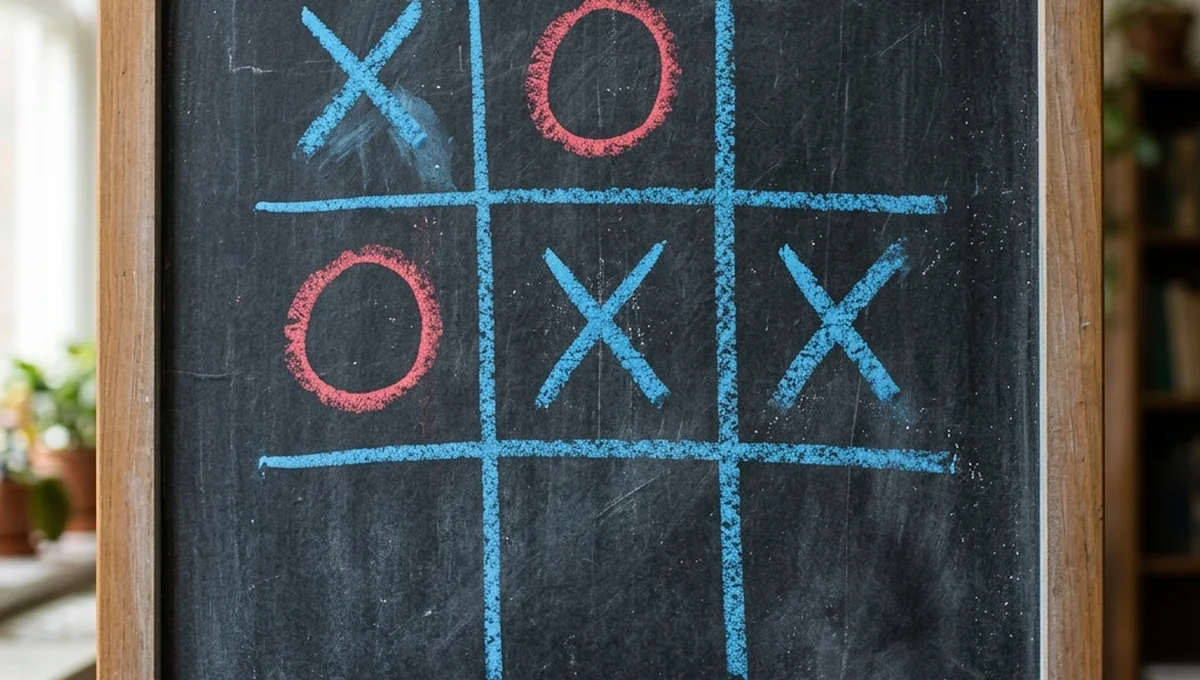
Unbeatable Strategy Flowchart
Learn the exact step-by-step flowchart logic that guarantees you will never lose another match, regardless of whether you go first or second.
Best Opening Moves Ranked
Should you start in a corner, center, or edge? We analyze the mathematical win rates of each starting position based on game theory.
How to Win Going Second
Playing second is a defensive challenge. Master the counter-opening moves required to neutralize Player 1's corner starts and secure wins.
Common Mistakes to Avoid
Identify the critical tactical blunders that lead to immediate losses. Spot opponent traps early and learn how to capitalize on minor errors.
Instant Play Web Games
Looking for more classic board games and puzzle variations? Discover the top free browser games you can play instantly without downloading.
Virtual Game Night Ideas
Learn how to organize the ultimate virtual game night. Gather printable grids, multiplayer codes, and fun tournament setups to play with friends.
The Ultimate Guide to Tic Tac Toe Strategy, Math, and History
Tic Tac Toe (also known as Noughts and Crosses in the UK and Ireland) is one of the oldest and most universally played paper-and-pencil games in human history. To a casual observer, the game seems incredibly basic: two players alternate placing X and O symbols on a 3x3 grid, each attempting to align three of their marks in a row. However, beneath this simple concept lies a rich domain of mathematics, combinatorics, game theory, and computer science. From its origins in the Roman Empire to its role in the development of modern artificial intelligence, Tic Tac Toe offers valuable lessons in logic, pattern recognition, and heuristics.
1. The Ancient Origins: A Game of Thousands of Years
Grid-based alignment games date back thousands of years. Archaeological evidence suggests that the ancient Egyptians played early variations of three-in-a-row games, carving game boards directly into the stone roofs of temples built around 1400 BCE. The Romans played a game called Terni Lapilli (Three Pebbles at a Time), which shared a similar 3x3 grid structure. However, unlike modern Tic Tac Toe where players place pieces that remain static, Terni Lapilli players only had three pebbles each and had to move their pieces around the board to create alignments. In the mid-19th century, the name "noughts and crosses" emerged in Britain, and by the 20th century, the game became globally known as Tic Tac Toe, cementing itself as a childhood favorite and a staple of logic classes.
2. The Mathematics of the 3x3 Grid
From a mathematical standpoint, Tic Tac Toe is classified as a finite, deterministic game of perfect information. "Perfect information" means that there are no elements of chance (such as rolling dice or drawing cards) and no hidden information (like a hand of cards). Both players have complete visibility of the entire game state at all times.
When analyzing the game's complexity, we can count the number of possible board configurations. At the first turn, Player 1 (X) can place their mark in any of the 9 empty cells. Player 2 (O) then chooses from the remaining 8 cells, and this branching continues until the board is full. The raw number of permutations for filling the grid is 9 factorial (9! = 362,880). However, this calculation is an upper bound that includes many illegal sequences where the game should have already ended because one player achieved three-in-a-row. When we exclude these invalid states and stop counting paths immediately when a win occurs, the number of unique gameplay sequences drops to 255,168.
If we take into account the geometric symmetries of the square grid (rotations and reflections), the complexity decreases further. The 9 grid cells collapse into only 3 unique starting positions: the center, the corners, and the edges. By applying group theory and symmetry reductions, the total number of unique terminal game states reduces to only 138. Of these, 91 states are won by Player 1 (X), 44 are won by Player 2 (O), and only 3 configurations result in a draw. This asymmetry highlights the inherent advantage of starting first, although optimal defensive play can neutralize this advantage.
3. Strategic Principles: Openings, Attacks, and Flawless Defense
Because Tic Tac Toe is a fully solved game, it has a clear Nash Equilibrium: if both players make optimal moves, the game will always end in a draw. To win a match, a player must set strategic traps that exploit their opponent's errors.
- The Corner Opening (Strongest Attack): Placing your first mark (as Player X) in a corner is strategically superior to the center. While the center square is part of four winning lines (one horizontal, one vertical, two diagonals), the corners are part of three lines but allow for much more effective trap building. If you start in a corner, Player 2 is forced to play in the center to avoid an immediate loss. If Player 2 makes the mistake of playing in any edge square, you can place your second mark in another corner, creating two winning paths (a "fork") that guarantee victory on the next move.
- Defending the Corner Start: If you are Player O and your opponent starts in a corner, you must immediately claim the center square. If Player X then plays in the opposite corner (forming a diagonal X-O-X line), you must play your next O on an edge cell, not a corner. Creating a line threat of your own forces Player X to respond defensively, preventing them from placing their third X in a corner to build a double-threat fork.
- The Center Opening: If Player X opens in the center, Player O must respond by playing in a corner. Taking an edge cell against a center opening is a critical blunder that allows Player X to block your lines while setting up multiple winning paths. By choosing a corner, Player O balances the board and ensures a draw.
- The Weakness of Edge Openings: Starting on an edge is the weakest opening move for Player X. It only participates in two winning lines, gives the opponent immediate control of the corners, and lacks the geometry needed to set up double-threat forks.
4. Tic Tac Toe in AI: The Minimax Search Algorithm
Due to its small state space, Tic Tac Toe is the classic model for teaching artificial intelligence search heuristics. The primary algorithm used to program an unbeatable AI opponent is the Minimax algorithm. This recursive algorithm simulates all possible future states of the game, assigning scores to the end states: +10 for a win by the maximizer (Player X), -10 for a win by the minimizer (Player O), and 0 for a draw.
By working backward from the terminal nodes, the algorithm determines the optimal move at any given state, assuming that the opponent will also play optimally. To optimize this process on larger games, programmers use Alpha-Beta Pruning, which stops evaluating a branch of the game tree as soon as it is proven to be worse than a previously searched option. This mathematical logic guarantees that the AI can never be beaten, demonstrating the power of search algorithms in game theory.
5. Educational and Cognitive Value
Beyond entertainment, Tic Tac Toe serves as an important developmental tool. For young learners, it introduces key concepts of spatial reasoning, visual grid alignment, predictive thinking (anticipating the opponent's moves), and rule adherence. In elementary classrooms, teachers utilize Tic Tac Toe choice boards as a method for differentiated instruction, letting students choose three assignments in a row to complete their coursework. For programming students, coding a Tic Tac Toe game is a rite of passage, helping them master multi-dimensional arrays, nested loops, conditional statements, and recursive algorithms.
Frequently Asked Questions
Is Tic Tac Toe actually a solved game?
Yes, Tic Tac Toe is a fully solved game. In game theory, this means the entire tree of possible moves has been mathematically mapped out. With perfect play from both players, the game will always result in a draw. Neither player can force a win if the opponent plays optimally.
What is the single best opening move to guarantee a win or draw?
The corner opening (placing your first mark in any of the four corner squares) is mathematically the strongest start. Although the center square offers more lines of alignment, a corner start forces the opponent into only one correct defensive choice (taking the center). Any other move by the opponent allows you to set up an unavoidable double-threat fork.
How do you escape or counter a corner fork trap?
To counter a corner fork trap when going second, you must first take the center square on turn one. If the opponent then claims the opposite corner on turn two, you must make a forcing move: play O on an edge cell. This creates a two-in-a-row line threat of your own, forcing the opponent to block you on their turn instead of executing their corner fork.
Can the second player (Player O) ever force a win?
No. Player O can never force a win because Player X goes first and holds the initial tempo. The best Player O can achieve under perfect play is a draw. However, if Player X makes a mistake (such as opening on an edge and failing to block Player O's counter-attack), Player O can secure a victory.
What is the main difference between Classic and Ultimate Tic Tac Toe?
Classic Tic Tac Toe is played on a single 3x3 grid. Ultimate Tic Tac Toe is a complex nested variation featuring a 3x3 grid of sub-grids (nine 3x3 boards in total). Winning a sub-grid allows you to claim that sector on the macro-board. Critically, your move in a sub-grid determines which sub-grid the opponent must play in next, introducing deep tactical layers and resolving the solved nature of the classic game.
Test Your Strategy Now
Put your new strategy knowledge to the test against our perfect AI engine or in real-time rooms.